

Mushroom Category Guide
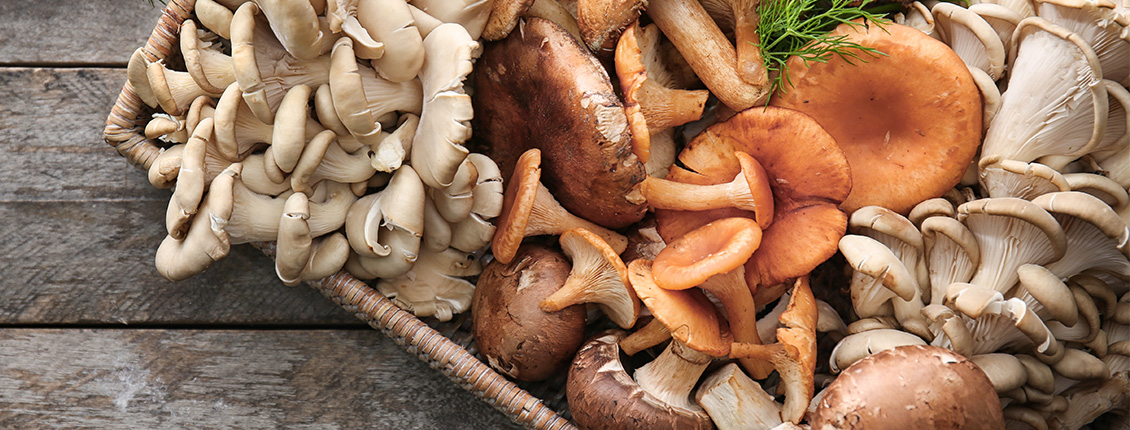
Before purchasing, discover everything you need to know about popular mushroom varieties, grades and standards, and storage and handling.
Popular Mushroom Varieties

White (Button)
Known for their smooth, rounded caps with short, truncated stems that vary in color from creamy white to light brown. Mild in flavor when raw and more intense, fragrant and meaty when cooked. Great for sautéeing, roasting, grilling or broiling.
Exotic Mushroom Varieties
Shitake
Varying from tan to dark brown, with broad umbrella-shaped caps, they have wide open veils and tan gills that have a rich and woodsy flavor when cooked. Commonly sautéed and used in stir fries, pastas, soups, entrées and sides. Stems are tough and should be cut off prior to cooking, but can be used to add flavor to stock.
Mushroom grades
U.S. No. 1
Consists of fresh mushrooms of similar varietal characteristics, which are mature, fairly well-shaped, well-trimmed, free from open veils, disease, spots, insect injury, decay or from damage by any cause. Size is specified in terms of diameter and, unless otherwise specified, meets the requirements of one of the following size classifications:
- Small to medium: Up to 1-5/8 inches in diameter
- Large: Over 1-5/8 inches in diameter
U.S. No. 2
The requirements for this grade are the same as for U.S. No. 1, except for a greater tolerance for open veils and a larger tolerance for defects.
Source: U.S. Department of Agriculture
Growth Process
Typically grown on a year-round cycle, mushrooms have one of the most interesting farm-to-fork agricultural stories, because mushrooms are technically considered fungi. Unlike plants, mushrooms lack chlorophyll to make their own food through photosynthesis, and instead exist on a substrate of organic material.
Mushroom Storage and Handling Tips
Follow these storage and handling tips to help maintain mushroom quality and shelf life.
- Immediately refrigerate both bulk and prepackaged mushrooms at 34° F (Blue Zone), closest to the cooler fan
- Keep in the original package and refrigerate
- Do not store in plastic bags or near pungent items
- Do not stack heavy items on top of mushroom containers, to prevent damage
- Typical shelf life from the time of harvest when kept under proper storage conditions:
- Most varieties: 5–8 days
- Shiitake: 8 days
- Oyster: 8 days
- Portabella: 8 day
- Fresh-cut: 5–8 days
- Most varieties: 5–8 days
- Wash mushrooms just prior to serving, under cold, running water. Only prepare what you will use in a day to avoid spoilage
- Use a soft brush to remove any traces of peat moss or soil, or rinse quickly and pat dry to clean
- Avoid soaking fresh mushrooms, or rinsing open veiled mushrooms, as it may add excess moisture