

Master Onion Selection: Varieties, Grades and Storage Essentials
Diced, chopped or sliced, onions bring delicious bite to just about anything you can cook. Learn more about onions and their different types, so you can make informed purchases for your operation. Discover everything you need to know to make the right onion purchasing decisions. Find information on onion varieties and flavors, onion sizing and grades, and onion storage and handling.
Popular Onion Varieties

Yellow
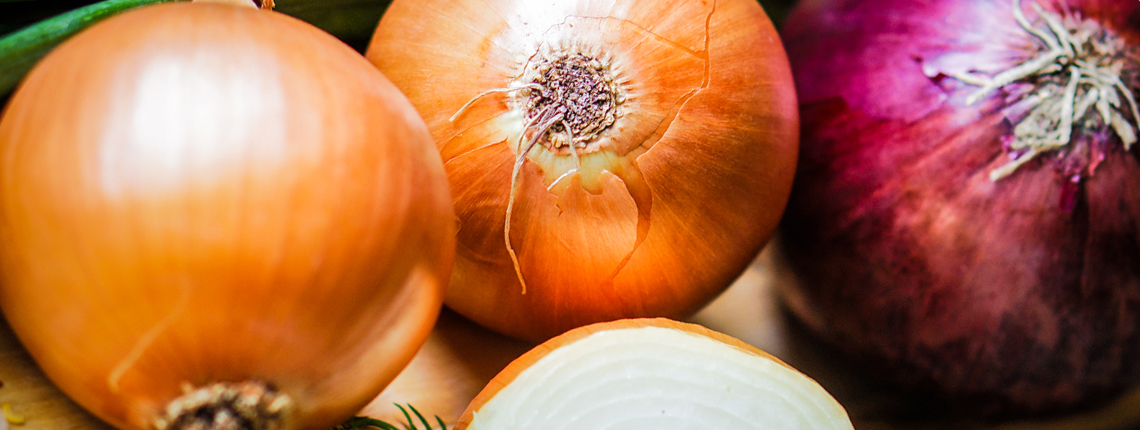
All-purpose and most popular. The majority of the U.S. onion crop is yellow. The most well-known sweet onions are yellow, including Walla Walla and Vidalia. Cooking brings out this variety's nutty, mellow, often sweet quality when caramelized. Yellow onions can be raw, grilled, sautéed or lightly cooked, caramelized, baked or roasted. Best used for salsas, sauces, soups or broths, burgers, onion blossoms, onion rings and pizzas.
Onion Sizes
Things you should know:
- Sizing applies to all grades and varieties
- Predominant size in foodservice is jumbo. Small sizes are usually packaged and sold for retail
- Colossal and Super Colossal are used for onion blossoms
- Onions are mainly an ingredient produce item. Only Colossals and Super Colossals are menued as appetizers, because of their size and sweetness
Onion Grades
As with other produce, onion grades are based on the product's appearance, including internal and external defects. The typical grades for onions are U.S. No. 1 and U.S. No. 2.
U.S. No. 1 Must Meet the Following Requirements:
- Similar varietal characteristics, except color when designated as a specialty or mixed pack
- Mature, fairly firm and fairly well-shaped
- Free from decay, wet sunscald, doubles, bottlenecks and scallions
- Free from damage caused by seedstems, splits, tops, roots, dry sunken areas, sunburn, sprouts, freezing, peeling, cracked fleshy scales, watery scales, dirt or staining, foreign matter, mechanical, translucent scales, disease, insects and other means
- Unless otherwise specified, the diameter should be not less than 1-1/2 inches; yellow, brown or red onions should have 40 percent or more, and white onions should have 30 percent or more, by weight, of the onions in any lot 2 inches or larger in diameter
- When a percentage of the onions is specified, to be of any certain size or larger, no part of any tolerance should be allowed to reduce the specified percentage. But individual packages in a lot may have as much as 25 percentage points less than the percentage specified, except that individual packages containing 10 pounds or less should have no requirements as to percentage of a certain size or larger, provided that any lot, regardless of package size, should average within the percentage specified
U.S. No. 2 Must Meet the Following Requirements:
- One type, except when designated as a specialty or mixed pack
- Mature, and not soft or spongy
- Free from decay, wet sunscald and scallions
- Free from serious damage caused by watery scales, dirt or staining, foreign matter, seedstems, sprouts, mechanical, dry sunken areas, disease, freezing, insects and other means
Source: U.S. Department of Agriculture
Onion Storage and Handling
Proper storing and handling are just as important as the quality of the pack, so that the product can be preserved as long as possible. Consider the following when storing onions:
- For extended storage, keep onions in a cool (40–55°F), dry area (Red Zone of cooler – closest to the door)
- Airflow is crucial to extending shelf life and performance of onions, so do not wrap whole onions in plastic or store in plastic bags
- Cut onions will keep for several days, if sealed in plastic bags or containers and refrigerated at 33–39°F
- Generally, the longer the onion is stored, the stronger the profile flavor becomes
- Store onions away from foods that absorb odors
- Onions are generally sold in bags to allow for proper air circulation